Postural Influences on Perceived Abdominal Distension

Understanding how body position affects fluid distribution, blood flow, and perception of gastrointestinal sensations.

Postural effects on fluid and blood circulation

Gravitational Effects on Body Fluid Distribution

Body position fundamentally affects gravitational fluid redistribution. Gravity continuously draws blood and interstitial fluid toward lower body regions, affecting central blood volume, renal perfusion, and fluid distribution within the abdomen.

Upright Posture Effects

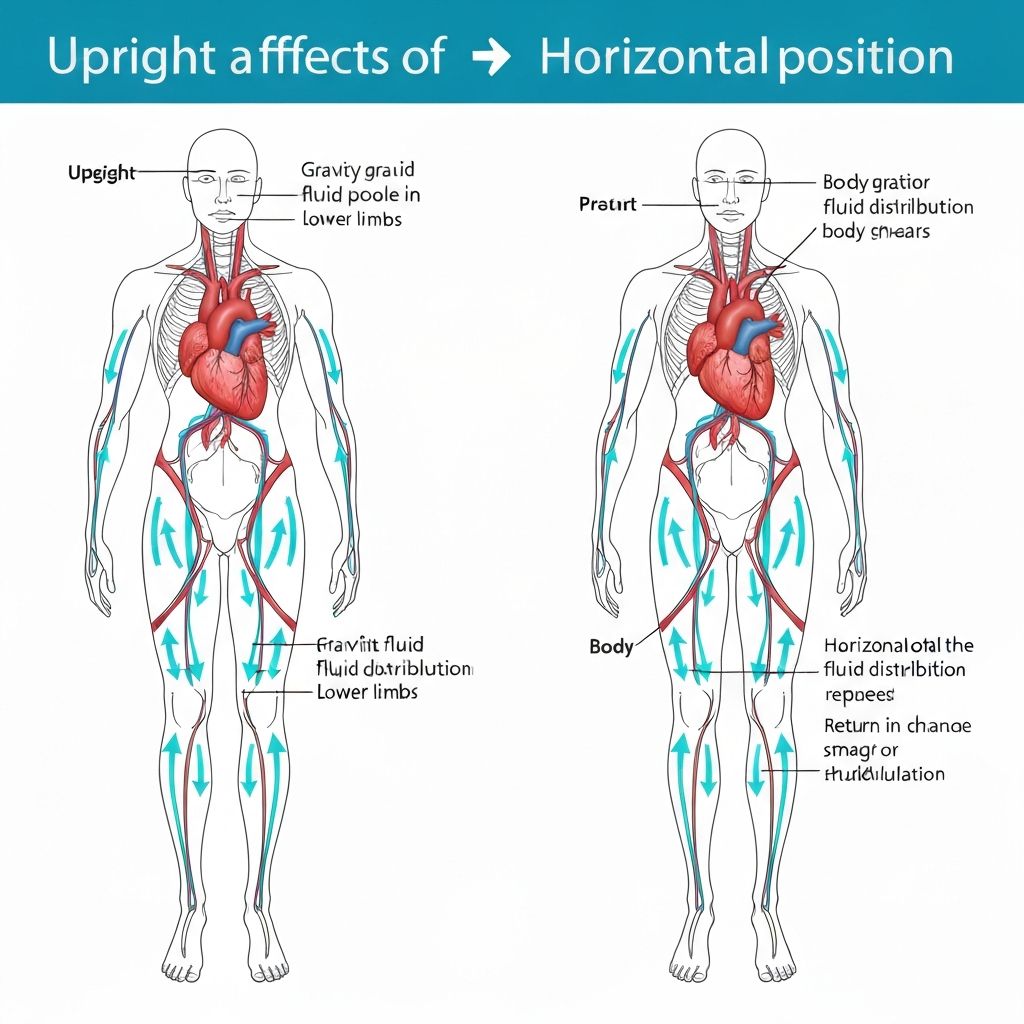
Standing position permits gravity to pull blood and fluid toward the legs and lower abdomen. Approximately 800 mL of blood shifts to the legs during standing. Central blood volume decreases temporarily, triggering baroreceptor reflex responses: increased heart rate, increased cardiac contractility, and sympathetic vasoconstriction in splanchnic and cutaneous vascular beds. These compensatory mechanisms restore cardiac output and central blood pressure.

Abdominal organs and their contents likewise shift downward with standing. Intestinal loops arrange more vertically in standing position compared to recumbent positions. This gravitational repositioning may reduce perceived abdominal distension despite unchanged absolute gas or fluid volumes, as the same volume distributes more linearly along the vertical axis rather than expanding anteroposterior abdominal wall. Individual abdominal wall laxity affects this perception; individuals with greater abdominal compliance may tolerate larger volume changes without pronounced distension sensation.

Recumbent Posture Effects

Lying supine redistributes blood centrally; approximately 800 mL returns to the central circulation. This volume expansion increases central blood pressure and renal perfusion pressure. Enhanced renal perfusion triggers several responses promoting sodium and water reabsorption: decreased renin release reduces angiotensin II production and aldosterone secretion, but simultaneously, atrial natriuretic peptide (ANP) secretion increases from atrial stretch. The net effect typically results in modest urinary sodium and water excretion.

Horizontally recumbent positioning allows abdominal contents to redistribute more widely. Gas and fluid spread laterally and anteroposteriorly, potentially increasing abdominal girth more than identical volumes in standing position. Increased perception of distension in recumbent positions likely reflects this more anterior abdominal wall stretch.

Renal Hemodynamics and Fluid Retention

Body position influences renal blood flow and glomerular filtration rate, producing changes in water and electrolyte handling.

Positional Changes in Renal Function

Standing decreases renal blood flow and glomerular filtration rate (GFR) due to reduced central blood volume and renal perfusion pressure. Reduced GFR decreases urinary sodium and water excretion. Simultaneously, sympathetic activation increases renin secretion, promoting sodium reabsorption through the renin-angiotensin-aldosterone system. Collectively, these changes promote fluid retention during upright posture.

Recumbent posture increases renal blood flow and GFR due to restored central blood volume. Enhanced GFR increases urinary sodium and water excretion. Simultaneously, decreased renin secretion reduces aldosterone stimulation. These combined effects promote sodium and water excretion during recumbency. Individuals who lie supine for extended periods typically experience increased urine output and weight loss, reflecting enhanced renal sodium and water excretion.

Prolonged Upright vs. Recumbent Effects

Extended periods in recumbent positions (bedridden individuals, hospitalized patients) can lead to significant fluid mobilization and urinary loss, contributing to weight loss and potential volume depletion if fluid intake is inadequate. Conversely, prolonged standing or reduced resting time is associated with relatively greater fluid retention, potentially contributing to lower extremity edema and increased abdominal distension perception in individuals with other predisposing factors.

Gastrointestinal Transit and Gas Clearance

Body position influences gastrointestinal motility and gas clearance patterns through mechanical and neural mechanisms.

Mechanical Effects

Gravitational effects on intestinal contents promote forward movement in standing or upright positions. Gas, being less dense than other intestinal contents, floats toward the superior aspect of the colon. In supine position, gas distribution becomes more anterior. In left lateral decubitus position, gas in the colon distributes different compared to supine or right lateral positions, affecting both gas clearance and perceived distension.

Certain yoga positions and body postures may facilitate gas clearance through mechanical repositioning. Movements that compress the abdomen or change body position alter intestinal pressure gradients, facilitating gas movement toward the rectum and potential elimination.

Motility Changes

Physical activity increases gastrointestinal motility through multiple mechanisms including increased intra-abdominal pressure, sympathetic nervous system modulation, and mechanoreceptor activation. Enhanced motility during activity promotes gas clearance and reduced gas accumulation. Conversely, recumbent rest reduces motor activity, potentially slowing gas clearance and permitting accumulation.

Abdominal Wall Muscle Tone and Posture

Body posture directly influences abdominal wall muscle tone, affecting the anterior abdominal wall's resistance to distension.

Postural Effects on Abdominal Muscle Tone

Upright posture requires active abdominal muscle engagement for postural stability. Rectus abdominis, oblique muscles, and transversus abdominis maintain baseline tension. This active muscle tone reduces abdominal wall compliance, limiting anterior wall excursion when gas or fluid accumulates. Individuals maintain more anterior posture with enhanced abdominal muscle engagement during standing.

Recumbent posture permits abdominal muscle relaxation. With relaxed abdominal musculature, the anterior abdominal wall becomes more compliant, allowing greater anterior excursion as intra-abdominal pressure increases. This enhanced compliance permits larger anterior abdominal wall protrusion with identical gas or fluid volumes compared to upright posture.

Slumped or flexed sitting postures (common during sedentary activities) reduce abdominal muscle engagement, similar to recumbent positioning. Prolonged flexed sitting may increase perceived distension compared to upright posture despite unchanged intraluminal contents.

Perception and Sensitivity in Different Positions

Beyond mechanical factors, body position influences how the nervous system perceives gastrointestinal sensations.

Attentional Modulation

Upright, activity-engaged postures typically involve external attention focus. Mental resources directed toward external environment may reduce interoceptive awareness of gastrointestinal sensations. Conversely, recumbent rest positions facilitate internal focus and increased interoceptive awareness. The same gas volume or distension may seem more pronounced when lying down with internal focus compared to active standing with external focus.

Sympathetic vs. Parasympathetic Dominance

Upright activity promotes sympathetic nervous system dominance (fight-or-flight), which inhibits gastrointestinal sensory perception and promotes motility. Recumbent rest promotes parasympathetic nervous system dominance (rest-and-digest), enhancing gastrointestinal sensory perception. This autonomic shift may increase distension awareness in recumbent positions despite identical mechanical distension.

Visceral Sensation Integration

Central nervous system processing of visceral sensations depends on context and expectation. Individuals may perceive identical sensations as less bothersome during engaging activities compared to quiet rest, reflecting higher-level cortical processing modulation of pain and distension perception.

Edema Formation and Postural Effects

Prolonged standing promotes fluid accumulation in lower extremities through hydrostatic pressure mechanisms. Sitting or lying down redistributes this accumulated fluid centrally, triggering urinary excretion.

Individuals with underlying conditions promoting edema (venous insufficiency, lymphatic dysfunction) may experience weight gain during the day from fluid accumulation in lower extremities and subcutaneous tissues. Evening recumbency promotes fluid redistribution and urinary excretion, reducing next-morning weight. Some individuals experience variable abdominal distension perception across the day, with reduced distension in the morning (after night-long recumbency) and increased distension in the evening (after prolonged standing or sitting). This postural-related fluid redistribution contributes to these diurnal variations independent of dietary or gastrointestinal factors.

Practical Observations on Posture and Distension

Understanding postural effects on fluid distribution and distension perception provides context for common everyday observations:

  • Increased abdominal distension perception in recumbent positions compared to standing
  • Morning weight lower than evening weight, reflecting night-long recumbent fluid redistribution
  • Ankle edema development during prolonged standing, resolving with elevation
  • Increased urinary output following recumbent rest periods
  • Reduced distension perception during physical activity compared to rest
  • Postural changes affecting visible abdominal profile and clothing fit
  • Variable symptom patterns across the day correlating with activity levels and rest periods

Return to Blog